EQUIPMENT SELECTION GUIDE
Guava Juice and Concentrate: Equipment Scope
Define a guava juice or concentrate route around extraction, screening, clarification, deaeration, heat treatment and the evaporation interface.
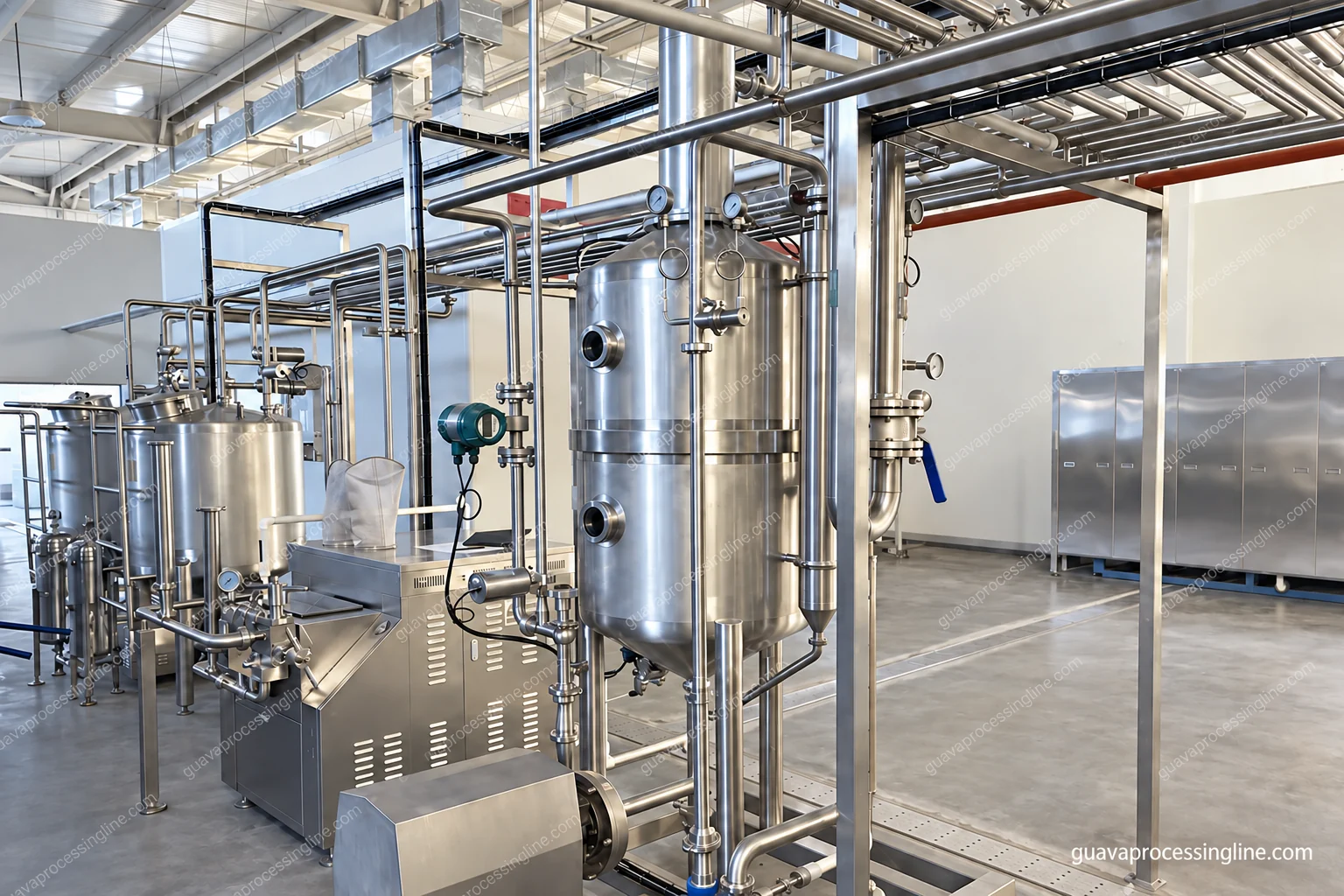
Three products need three different boundaries
Cloudy guava juice or nectar base, clear guava juice and guava concentrate are not interchangeable names for pulp. Define the fruit fraction, total soluble solids, acidity, pulp or particle content, clarity, preservation route and package before choosing equipment. Water, sugar or other recipe ingredients create a formulated product; their volume is not additional fruit extraction.
Extraction and screening control the starting solids
The double-stage pulper/refiner separates recovered pulp from skins, seeds and coarse fibre. For juice, the screen and operating duty influence pulp body, hard-particle risk and the load on any later clarification. Run a matched screen trial rather than copying a number from another fruit lot. A finer screen changes flow and residue; it is not a seed-fragment guarantee.
Clarification is a separate process package
Clear juice usually needs more than a pulper screen. FAO Agricultural Services Bulletin 119 (1995) describes a clear guava juice route using depectinised purée, followed by centrifuging or pressing and filtration. Those steps require enzyme dosing and holding, a separation device, filtration and their own cleaning and validation. The equipment families listed on this site do not include that clarification train; define it as a separate package or a named interface.
Deaeration and heat treatment support the route
Entrained air and foam can affect appearance, transfer and thermal performance. A vacuum deaerator may be justified for a compatible pumpable feed, and a tubular treatment system can heat, hold and cool the product within a defined process. Neither step creates clarity or removes hard seeds. Match the thermal process to the recipe, acidity, package and agreed preservation validation rather than a generic temperature.
Concentration is an evaporation interface
A concentrate is produced by removing water, usually under vacuum, after the feed has been prepared and stabilised. FAO’s general fruit-juice discussion cites 40–65 Brix or 4–7 fold for concentrates; these are broad reference figures, not a guava target or a guarantee from this equipment scope. Aroma recovery, evaporator design and concentrate standardisation are separate decisions. Give the evaporator supplier the feed solids, acidity, pulp/particle condition, viscosity with temperature and method, flow, available utilities and required concentrate specification.
Package the product you have actually defined
Bulk aseptic bags suit compatible pulp, purée or prepared base where the upstream process and filling boundary are engineered together. A clear juice or concentrate may need a different preservation and packaging arrangement, and retail bottles, cans or cartons need their own filler. State the handover condition, not only the product name.
A useful first brief
Send the intended product (cloudy juice, clear juice, nectar base or concentrate), incoming fruit or pulp, target solids and acidity, planned flow at a named boundary, package, existing clarification or evaporation equipment, and any trial observations. If evaporation or clarification is not yet defined, say so; it is better than assigning an assumed performance figure.
TECHNICAL REFERENCE
Historical process reference for guava purée screening, clear-juice preparation and concentrate context. Figures are cited examples, not universal settings or current equipment performance.
LET’S DEFINE YOUR EQUIPMENT SCOPE
What are you planning
to process?
Share your fruit or pulp, target product and planned quantity. We can start with a short brief.