GUAVA PROCESSING EQUIPMENT
Double-Stage Guava Pulper and Refiner
One combined extraction and refining assembly with two working stages for separating pulp from retained skins, seeds and coarse fibre.
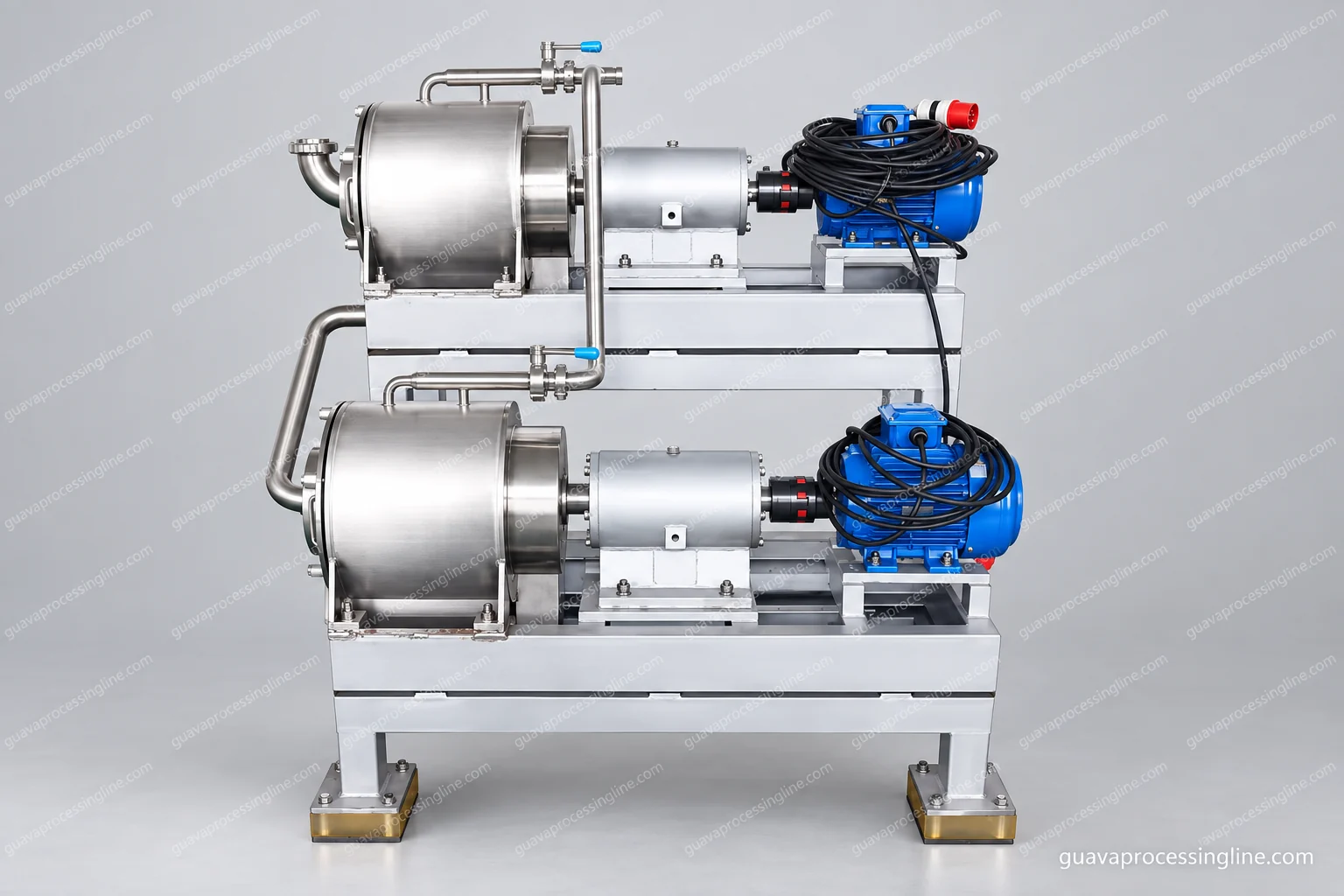
View inlet-side arrangement
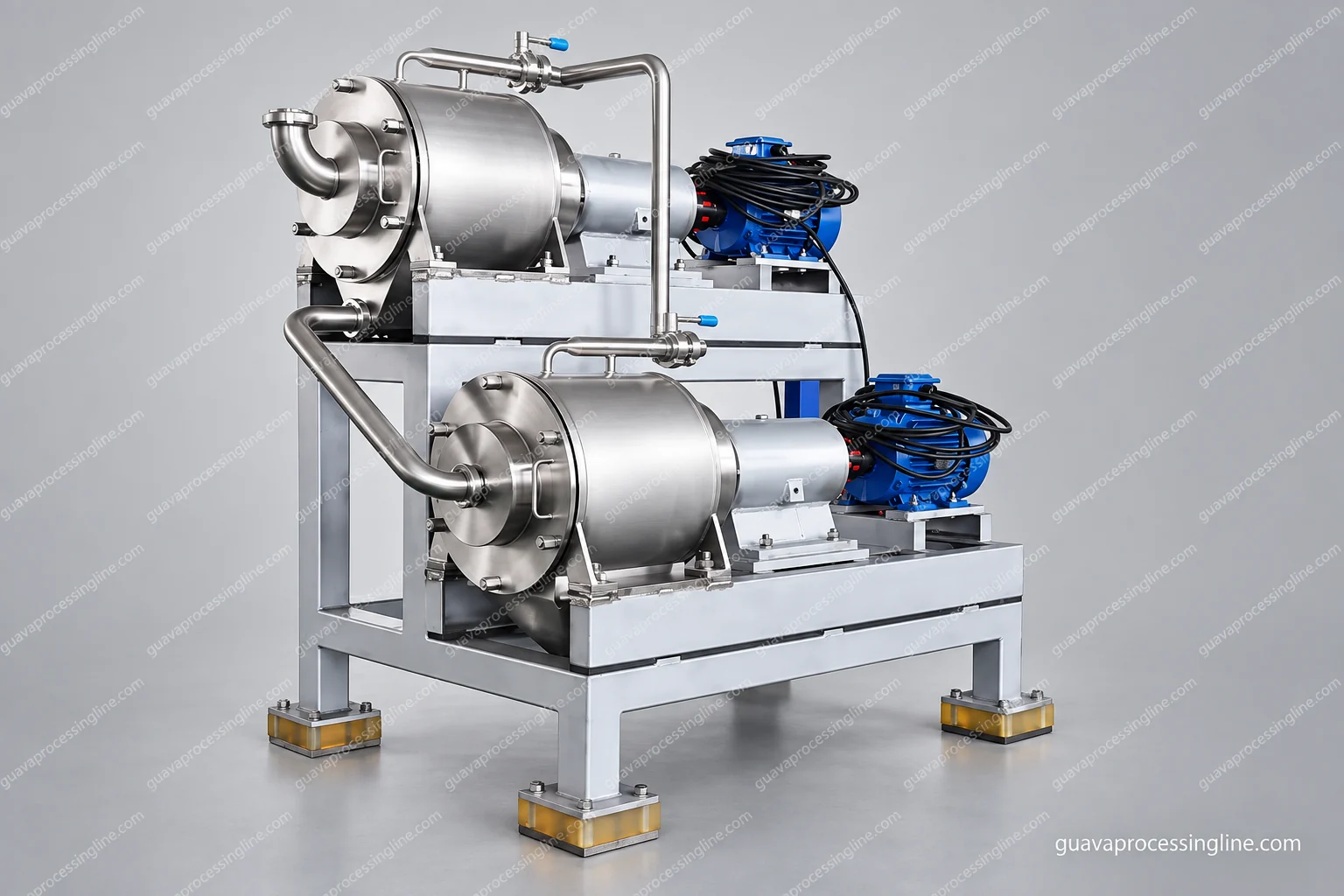
CONFIGURATION & DUTY
Equipment reference
| Family | DJ-3 / DJ-5 / DJ-10 / DJ-15 / DJ-25 |
|---|---|
| Published family duty | 1–3 / 5 / 10 / 15 / 25 t/h |
| Corresponding motor power | 4×2 / 7.5×2 / 18.5×2 / 30+18.5 / 45+37 kW |
| Published screen range | 0.4–1.5 mm; selected for the extraction/refining task |
| Rating boundary | General family data; guava trials establish accepted product and operating duty |
Two working stages in one assembly
Prepared fruit enters the first working housing, where rotor action presents material to a perforated screen. The recovered stream progresses to the next stage for refinement; retained material is discharged separately. The combined assembly handles both duties without treating them as two unrelated product models.
Seeds and fibre require different observations
Guava seeds are hard, while retained fibre can affect texture and screen loading. Evaluate the pulp and residue from the selected preparation and operating settings. A finer screen may change flow and retained pulp; its opening is not a maximum-particle or seed-fragment guarantee.
Family selection and trial duty
DJ family references describe available capacity and drive combinations. Match a proposal to feed condition, loading and the agreed product criteria. Confirm the proposed capacity and drive combination against representative fruit and the accepted pulp specification before fixing the line duty.
Screen access and cleaning
Stop and isolate both stages before opening the working housings. Inspect screen condition, rotor clearances, seals and residue passages using the selected assembly instructions. Direct access and inspection remain necessary where fibrous material can be trapped; a circulation rinse alone does not prove removal.
Connect the discharge paths
Give the pulp outlet a short, accessible route to the buffer and transfer arrangement. Collect residue away from exposed product and retain safe sampling access. A stable feed, free residue discharge and enough downstream buffer help the stages operate together.
PAIRED TRIAL / DOUBLE-STAGE PULPER
Read the product and the reject together.
Assign a lot and run ID before changing a screen or preparation step. Collect product and residue over the same stable interval, then retain a separate sample from each working-stage outlet where safely accessible.
| Record point | What travels with the sample | Comparison |
|---|---|---|
| Feed lot | Lot ID, maturity, preparation, feed temperature, collection interval | Keep the same lot while comparing one setting. |
| Screen before / after | Stage ID, screen reference / aperture, condition, damage or blocking; inspect only after safe isolation | Link a change in texture or flow to the actual fitted screen. |
| Accepted product | Sample ID, mass, seed-fragment assessment method, gritty-texture method and temperature | Hard fragments and stone-cell mouthfeel are separate observations. |
| Retained residue | Matched sample ID and mass, intact / broken seeds, skin, fibre and visible pulp carry-over | Read residue alongside the accepted product rather than recovery alone. |
SELECTION GUIDANCE
Read before you specify.
Use the technical guide alongside the equipment reference. The right screen, configuration and handover depend on the fruit, product criterion and connected process.
LINE CONNECTIONS
Place this equipment in a processing route.
RELATED MACHINES
Continue along the product path.
COMMON SELECTION QUESTIONS
A few things worth knowing.
Does a double-stage pulper need a separate finisher?
The featured assembly combines primary extraction and further refinement in two working stages. Additional equipment is assessed against the actual product specification, rather than assumed from the product name.
Which screen should I choose?
The published family range is 0.4–1.5 mm. Select a trial starting point against the fruit, hard-particle and fibre criteria. Aperture alone does not guarantee finished-pulp particle size.
Can I order this machine without a complete line?
Yes. Describe the duty at the double-stage guava pulper and refiner inlet and outlet, your planned quantity and any existing equipment connections. A single-machine scope can be discussed separately from a full processing line.
Which capacity or configuration should I request?
Share incoming material, accepted product, planned quantity at a named measurement point and the next process or package. Selection is based on that duty; a photograph alone does not establish an exact model or operating rate.
LET’S DEFINE YOUR EQUIPMENT SCOPE
What are you planning
to process?
Share your fruit or pulp, target product and planned quantity. We can start with a short brief.